DNA Vaccines & Anti-DNA Antibody ELISA Kits |
|
Vaccines are among the greatest achievements of modern medicine. Global use of vaccines have eliminated naturally occurring cases of smallpox, and nearly eliminated polio, while other diseases, such as typhus, rotavirus, hepatitis A and B and others are well controlled. Conventional vaccines, however, only cover a small number of diseases, and infections that lack effective vaccines kill millions of people every year, with AIDS, hepatitis C and malaria being particularly common. First generation vaccines are whole-organism vaccines - either live and weakened, or killed forms. Live, attenuated vaccines, such as smallpox and polio vaccines, are able to induce killer T-cell (TC or CTL) responses, helper T-cell (TH) responses and antibody immunity. However, there is a small risk that attenuated forms of a pathogen can revert to a dangerous form, and may still be able to cause disease in immuno-compromised vaccine recipients (such as those with AIDS). While killed vaccines do not have this risk, they cannot generate specific killer T cell responses, and may not work at all for some diseases.Second generation vaccines consisting of defined protein antigens (such as tetanus or diphtheria toxoid) or recombinant protein components (such as the hepatitis B surface antigen) were developed to minimize risk and cost of the whole cell vaccines. Subunit vaccines are also able to generate TH and antibody responses, but not killer T cell responses. DNA vaccine idea started with the landmark discovery of protein expression by the injection of naked DNA into mouse muscle Wolff in 1990. DNA vaccines are third generation vaccines, and are made up of a small, circular piece of bacterial DNA (called a plasmid) that has been genetically engineered to produce one or two specific proteins (antigens) from a pathogen. The vaccine DNA is injected into the cells of the body, where the "inner machinery" of the host cells "reads" the DNA and uses it to synthesize the pathogen's proteins. Because these proteins are recognized as foreign, when they are processed by the host cells and displayed on their surface, the immune system is alerted, which then triggers a range of immune responses.
|
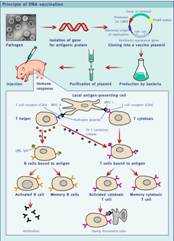 Success of the vaccine depends upon high expression of the target antigen from the injected gene (DNA). DNA immunization is able to raise a
range of TH responses, including lymphoproliferation and the generation of a variety of cytokine profiles. A major advantage of DNA vaccines is the ease with which they
can be manipulated to bias the type of T-cell help towards a TH1 or TH2 response. The type of T-cell help raised is influenced by the method of delivery and the type of immunogen
expressed, as well as the targeting of different lymphoid compartments. Generally, saline needle injections (either IM or ID) tend to induce TH1 responses, while gene gun delivery raises TH2
responses. One of the greatest advantages of DNA vaccines is that they are able to induce cytotoxic T lymphocytes (CTL) without the inherent risk associated with live
vaccines. CTL responses can be raised against immunodominant and immunorecessive CTL epitopes, as well as subdominant CTL epitopes, in a manner which appears to mimic natural
infection. This may prove to be a useful tool in assessing CTL epitopes of an antigen, and their role in providing immunity. The efficiency of DNA immunization can be improved by stabilising DNA
against degradation, and increasing the efficiency of delivery of DNA into antigen presenting cells. This has been demonstrated by coating biodegradable cationic microparticles
(such as poly(lactide-co-glycolide) formulated with cetyltrimethylammonium bromide) with DNA. Such DNA-coated microparticles can be as effective at raising CTL as recombinant vaccinia viruses,
especially when mixed with alum. Alternative delivery methods have included aerosol instillation of naked DNA on mucosal surfaces, such as the nasal and lung mucosa, and topical administration of pDNA
to the eye and vaginal mucosa. Mucosal surface delivery has also been achieved using cationic liposome-DNA preparations, biodegradable microspheres, attenuated Shigella
or Listeria vectors for oral administration to the intestinal mucosa, and recombinant adenovirus vectors.
Success of the vaccine depends upon high expression of the target antigen from the injected gene (DNA). DNA immunization is able to raise a
range of TH responses, including lymphoproliferation and the generation of a variety of cytokine profiles. A major advantage of DNA vaccines is the ease with which they
can be manipulated to bias the type of T-cell help towards a TH1 or TH2 response. The type of T-cell help raised is influenced by the method of delivery and the type of immunogen
expressed, as well as the targeting of different lymphoid compartments. Generally, saline needle injections (either IM or ID) tend to induce TH1 responses, while gene gun delivery raises TH2
responses. One of the greatest advantages of DNA vaccines is that they are able to induce cytotoxic T lymphocytes (CTL) without the inherent risk associated with live
vaccines. CTL responses can be raised against immunodominant and immunorecessive CTL epitopes, as well as subdominant CTL epitopes, in a manner which appears to mimic natural
infection. This may prove to be a useful tool in assessing CTL epitopes of an antigen, and their role in providing immunity. The efficiency of DNA immunization can be improved by stabilising DNA
against degradation, and increasing the efficiency of delivery of DNA into antigen presenting cells. This has been demonstrated by coating biodegradable cationic microparticles
(such as poly(lactide-co-glycolide) formulated with cetyltrimethylammonium bromide) with DNA. Such DNA-coated microparticles can be as effective at raising CTL as recombinant vaccinia viruses,
especially when mixed with alum. Alternative delivery methods have included aerosol instillation of naked DNA on mucosal surfaces, such as the nasal and lung mucosa, and topical administration of pDNA
to the eye and vaginal mucosa. Mucosal surface delivery has also been achieved using cationic liposome-DNA preparations, biodegradable microspheres, attenuated Shigella
or Listeria vectors for oral administration to the intestinal mucosa, and recombinant adenovirus vectors.
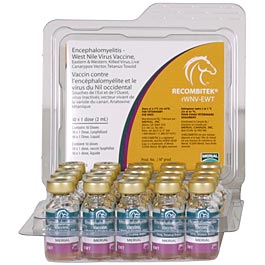 DNA Vaccines Status: Several hundred clinical trials are ongoing at various stages for
DNA vaccines. Positive results were announced for a bird flu DNA vaccine in 2006 (H5N1). A DNA vaccine to protect horses from West Nile virus (recombitek, Fort Dodge)
has been approved in 2004. rWNV consists of a canarypox virus vector with insertion and expression of the membrane (prM) and envelope (E)proteins of WNV genes.
The latest equine vaccine approved in 2006 is a single-dose, attenuated West Nile virus, live flavivirus chimera vaccine (WN-FV)(PreveNile Intervet, De Soto, KS)
for horses and is marketed without an adjuvant. The recombinant chimera expresses the E and prM proteins of WNV in a yellow fever vector (YF17D).
The vaccine has been labeled for use in horses for the prevention of West Nile virus viremia and as an aid in the prevention of WNV disease and encephalitis.
A preliminary study in DNA vaccination against multiple sclerosis (BHT-3009 by Bayhill Therapeutics) was reported as being effective.
The MS vaccine expressed full length human myelin basic protein (MBP) and reduced the levels of autoantibodies to MBS.
DNA Vaccines Status: Several hundred clinical trials are ongoing at various stages for
DNA vaccines. Positive results were announced for a bird flu DNA vaccine in 2006 (H5N1). A DNA vaccine to protect horses from West Nile virus (recombitek, Fort Dodge)
has been approved in 2004. rWNV consists of a canarypox virus vector with insertion and expression of the membrane (prM) and envelope (E)proteins of WNV genes.
The latest equine vaccine approved in 2006 is a single-dose, attenuated West Nile virus, live flavivirus chimera vaccine (WN-FV)(PreveNile Intervet, De Soto, KS)
for horses and is marketed without an adjuvant. The recombinant chimera expresses the E and prM proteins of WNV in a yellow fever vector (YF17D).
The vaccine has been labeled for use in horses for the prevention of West Nile virus viremia and as an aid in the prevention of WNV disease and encephalitis.
A preliminary study in DNA vaccination against multiple sclerosis (BHT-3009 by Bayhill Therapeutics) was reported as being effective.
The MS vaccine expressed full length human myelin basic protein (MBP) and reduced the levels of autoantibodies to MBS.
DNA Vaccines & Anti-DNA Antibody ELISA Kits |
|
Items |
Ab isotype |
Mouse Cat# |
Rat Cat# |
Human Cat# |
Monkey Cat# |
|
DNA Vaccine Anti-dsDNA IgG ELISA |
Ig's (G+A+M) |
5110 |
|
|
670-100-DNM |
|
IgG (IgG1-3) |
5120 |
650-130-DDN |
3100 |
|
|
|
IgG1 |
5120-1 |
|
|
|
|
|
IgG2a |
5120-2a |
|
|
|
|
|
IgG2b |
5120-2b |
|
|
|
|
|
IgG3 |
5120-3 |
|
|
|
|
|
IgA |
5120-A |
|
3105 |
|
|
|
IgM |
5130 |
|
3110 |
|
|
|
IgE |
5120-E |
|
|
|
|
|
Vaccine Anti-ssDNA IgG ELISA |
Ig's (G+A+M) |
5310 |
|
|
|
IgG |
5320 |
650-330-DSN |
|
|
|
DNA Vaccine Antibody Detection DNA-vaccine typically contain a protein expression vector that is expected to be translated by the host (mouse, human etc). For example, recombitek, rWNV, Fort Dodge, DNA Vaccine expresses the membrane (prM) and envelope (E) proteins of West Nile Virus. The success of the vaccine will depend upon the expression of the protein followed by the production of antibodies in mouse or human or other host receiving the DNA vaccine. Serum antibodies are generally detected by direct antigen ELISAs. ADI has produced ELISA kits that contain optimized reagents including the specific antibody conjugates necessary to detect the antibodies. Users will only supply the specific antigen for coating the ELISA plates. Antibody detection can be completed in <2 hours using supplied reagents in the kit. |
|
Catalog |
Product Description |
Product Type |
|
80120 |
(Deer, Elk, Moose Serum Antibody detection ELISA kit, Qualitative |
Kit |
|
80150 |
Mouse Serum Antibody detection ELISA kit, Qualitative |
Kit |
|
80155 |
Rat Serum Antibody detection ELISA kit, Qualitative |
Kit |
|
80160 |
Rabbit Serum Antibody detection ELISA kit, Qualitative |
Kit |
|
80165 |
Goat Serum Antibody detection ELISA kit, Qualitative |
Kit |
|
80166 |
Sheep Serum Antibody detection ELISA kit, Qualitative |
Kit |
|
80170 |
Human Serum Antibody detection ELISA kit, Qualitative |
Kit |
|
80171 |
G. Pig Serum Antibody detection ELISA kit, Qualitative |
Kit |
|
80175 |
Monkey Serum Antibody detection ELISA kit, Qualitative |
Kit |
|
80176 |
Chicken Serum Antibody detection ELISA kit, Qualitative |
Kit |
|
80177 |
Chicken IgY Antibody detection in whole egg yolks ELISA kit, Qualitative |
Kit |
|
80180 |
Hamster Serum Antibody detection ELISA kit, Qualitative |
Kit |
|
80185 |
Bovine Serum Antibody detection ELISA kit, Qualitative |
Kit |
|
80186 |
Pig Serum Antibody detection ELISA kit, Qualitative |
Kit |
|
80187 |
Turkey Serum Antibody detection ELISA kit, Qualitative |
Kit |
|
80188 |
Ferret Serum Antibody detection ELISA kit, Qualitative |
Kit |
|
80188-A |
Ferret Serum antigen-specific IgA Antibody detection and titration ELISA kit |
Kit |
|
80188-G |
Ferret Serum antigen-specific IgG Antibody detection and titration ELISA kit |
Kit |
80188-M |
Ferret Serum antigen-specific IgM Antibody detection and titration ELISA kit |
Kit |

